Ethereum History Changed Global Blockchain Innovation
Ethereum is one of the most influential blockchain platforms ever created. While Bitcoin introduced decentralized digital money, Ethereum expanded blockchain capabilities by enabling smart contracts and decentralized applications.
Since its launch in 2015, Ethereum has become the foundation for decentralized finance, NFTs, blockchain gaming, and Web3 innovation.
The Beginning Of Ethereum
Ethereum was proposed in late 2013 by programmer Vitalik Buterin. At the time, Vitalik was involved in the Bitcoin community and recognized blockchain technology’s enormous potential.
However, he believed Bitcoin’s scripting system was too limited for building complex decentralized applications.
Vitalik envisioned a programmable blockchain capable of supporting various decentralized use cases beyond digital payments.
The Ethereum Whitepaper
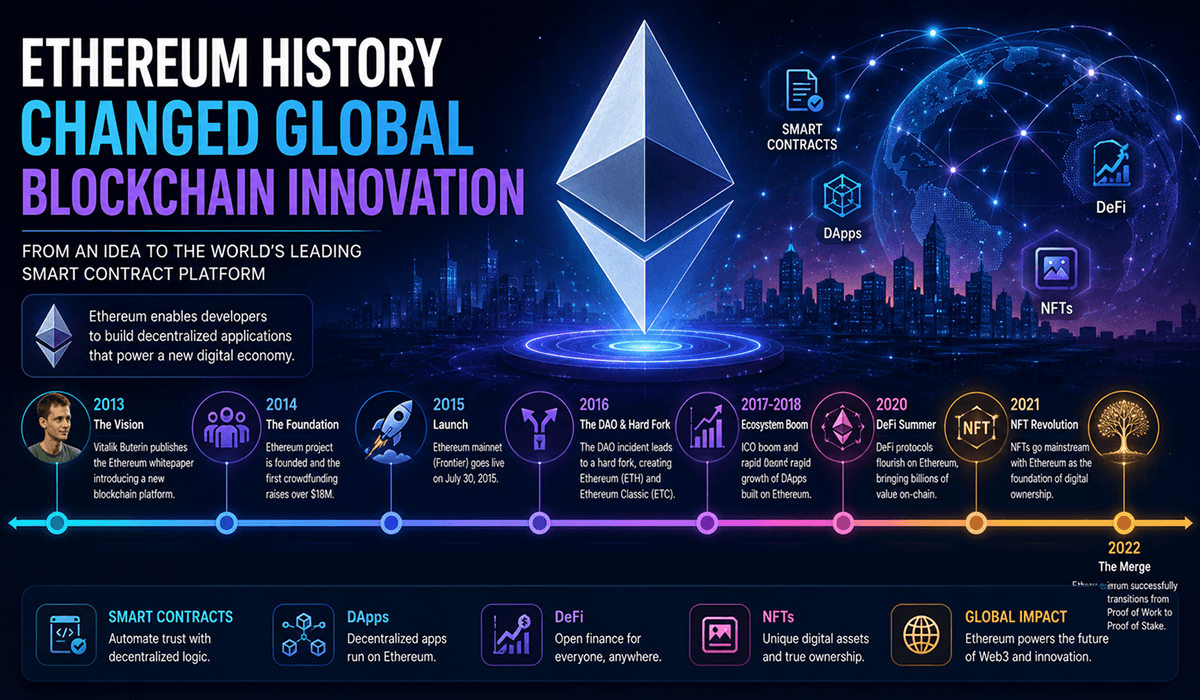
In 2013, Vitalik Buterin published the Ethereum whitepaper describing a decentralized platform that could execute smart contracts automatically.
Smart contracts are self-executing agreements where rules are written directly into blockchain code. These contracts remove the need for intermediaries and enable trustless transactions.
The Ethereum concept quickly attracted developers and blockchain enthusiasts interested in expanding decentralized technology.
Ethereum Founders And Development
Ethereum was co-founded by several notable individuals including Vitalik Buterin, Gavin Wood, Joseph Lubin, Charles Hoskinson, and Anthony Di Iorio.
The project officially began development in 2014 after a successful crowdfunding campaign that raised millions of dollars through Ether token sales.
This early funding allowed the Ethereum Foundation to support research, development, and ecosystem growth.
The Launch Of Ethereum
Ethereum officially launched on July 30, 2015, with the release of Frontier, the network’s first live version.
The native cryptocurrency Ether became the fuel powering transactions and smart contract execution across the network.
Developers quickly began experimenting with decentralized applications, opening entirely new possibilities for blockchain technology.
Smart Contracts Revolution
One of Ethereum’s biggest innovations was the introduction of programmable smart contracts. Unlike Bitcoin’s limited scripting language, Ethereum provided developers with flexible tools for creating decentralized systems.
Smart contracts enabled automated lending, decentralized exchanges, blockchain games, NFT marketplaces, and many other applications.
This innovation transformed Ethereum into the leading blockchain platform for developers worldwide.
The Rise Of ICOs
Between 2016 and 2018, Ethereum became the center of the Initial Coin Offering or ICO boom. Startups used Ethereum smart contracts to launch blockchain tokens and raise funding from investors globally.
Although many projects failed or faced regulatory issues, the ICO era demonstrated Ethereum’s ability to support tokenized ecosystems.
The DAO Incident
One of Ethereum’s most important historical events occurred in 2016 with the launch of The DAO, a decentralized investment fund built on Ethereum.
The DAO raised millions of dollars worth of Ether before hackers exploited vulnerabilities within its smart contract code.
To recover stolen funds, the Ethereum community voted to perform a hard fork. This decision created two separate blockchains: Ethereum and Ethereum Classic.
The incident highlighted both the power and risks of smart contract technology.
Ethereum And DeFi Growth
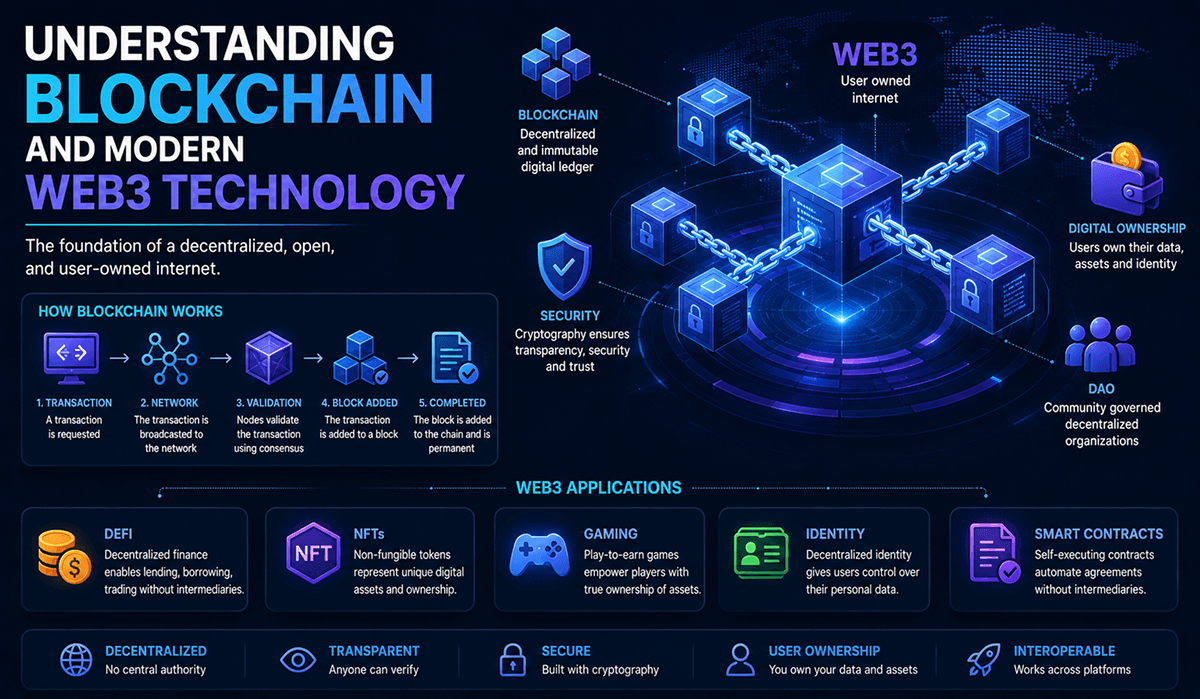
Ethereum later became the foundation of Decentralized Finance or DeFi. Platforms built on Ethereum allowed users to borrow, lend, trade, and earn interest without banks.
Protocols such as decentralized exchanges and yield farming platforms attracted billions of dollars into the DeFi ecosystem.
Ethereum’s programmable infrastructure made it the dominant blockchain for financial innovation.
The NFT Revolution
Ethereum also played a major role in the rise of Non-Fungible Tokens or NFTs. NFT standards such as ERC-721 enabled developers to create unique blockchain-based digital assets.
Artists, creators, brands, and gaming companies adopted Ethereum NFTs for digital ownership and collectibles.
The NFT market brought blockchain technology into mainstream media and popular culture worldwide.
Ethereum Transition To Proof Of Stake
Originally, Ethereum used a Proof-of-Work consensus system similar to Bitcoin mining. However, concerns about scalability and energy consumption pushed developers toward a more efficient model.
In 2022, Ethereum completed one of the biggest upgrades in blockchain history known as The Merge. This transition moved Ethereum from Proof-of-Work to Proof-of-Stake.
The upgrade significantly reduced energy consumption while improving long-term scalability plans.
Ethereum Today
Today, Ethereum remains one of the largest blockchain ecosystems globally. Thousands of decentralized applications operate on Ethereum across finance, gaming, AI, identity, and social platforms.
Major companies and institutions continue exploring Ethereum technology for tokenization, payments, and decentralized infrastructure.
Developers actively work on Layer 2 scaling solutions to reduce transaction costs and improve network performance.
The Future Of Ethereum
Ethereum’s future appears highly promising as Web3 adoption continues growing. Innovations involving artificial intelligence, decentralized social media, tokenized real-world assets, and blockchain gaming are expected to rely heavily on Ethereum infrastructure.
Scalability improvements and developer activity will likely strengthen Ethereum’s position as a leading programmable blockchain platform.
Conclusion
The history of Ethereum represents a major evolution in blockchain technology. By introducing smart contracts and decentralized applications, Ethereum transformed blockchain from a payment system into a global development platform.
Its influence continues shaping decentralized finance, NFTs, Web3, and future internet technologies worldwide. Ethereum remains one of the most important innovations driving the next generation of digital ecosystems.