History Behind Modern Golang Programming Language
Golang, commonly known as Go, is one of the most influential modern programming languages in software engineering history. Created by Google engineers to solve infrastructure scalability and software complexity problems, Go quickly became one of the most respected programming languages for backend systems, cloud computing, DevOps infrastructure, APIs, distributed systems, and blockchain development.
Unlike many traditional programming languages, Go was designed with simplicity, readability, performance, and concurrency as core priorities. Since its public release in 2009, Golang has experienced massive growth across startups, enterprise systems, cloud-native applications, and Web3 ecosystems.
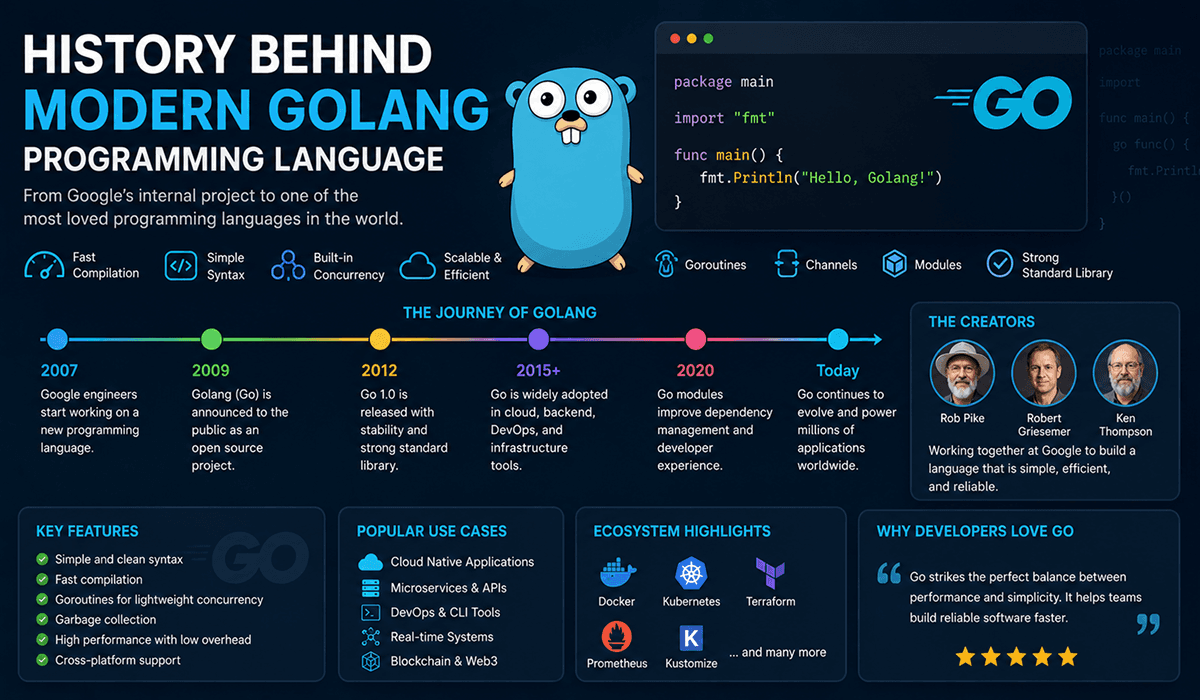
Today, Golang powers some of the world’s largest infrastructure tools and platforms, including Docker, Kubernetes, Terraform, Prometheus, and many blockchain clients. Understanding the history of Golang helps developers appreciate why Go became such a dominant force in modern backend engineering.
The Technology Challenges Before Golang
Before Go existed, software engineers at Google faced increasingly difficult infrastructure challenges. Google managed enormous distributed systems, search engines, advertising platforms, and cloud infrastructure handling billions of requests daily.
At the time, developers mainly relied on languages such as C++, Java, and Python. While these languages were powerful, they introduced several problems for large-scale infrastructure development.
C++ provided excellent performance but often became overly complex for large engineering teams. Compilation times were slow, dependency management became difficult, and maintaining large codebases required significant effort.
Java improved developer productivity but introduced heavier runtime overhead and more verbose syntax. Python simplified development but lacked the performance required for many infrastructure-level systems.
Google engineers realized they needed a new language capable of combining the best aspects of performance, simplicity, concurrency, and fast development.
The Creation Of Golang
Golang was officially created in 2007 at Google by three legendary computer scientists: Robert Griesemer, Rob Pike, and Ken Thompson.
Each creator brought deep experience from computer science and operating systems development.
Ken Thompson was already famous for co-creating the Unix operating system and the B programming language, which heavily influenced the creation of the C programming language.
Rob Pike contributed significantly to Unix systems and distributed computing research, while Robert Griesemer had extensive experience in compilers and systems programming.
Together, they designed Go to address modern infrastructure engineering challenges faced by Google.
The Main Philosophy Behind Golang
One of the biggest reasons behind Golang’s success is its strong design philosophy. The creators intentionally avoided unnecessary complexity and focused heavily on simplicity.
Go was designed to be:
- Easy to learn
- Easy to read
- Fast to compile
- Efficient for concurrent programming
- Scalable for distributed systems
- Reliable for production infrastructure
Unlike many programming languages that continuously add complicated features, Go focused on minimalism and maintainability.
The language creators believed software engineering should prioritize readability and long-term maintainability rather than excessive abstraction.
The Public Announcement Of Go
Google officially announced Go as an open-source programming language in November 2009.
The release quickly attracted attention from developers interested in scalable infrastructure and backend systems. Many engineers were excited because Go promised simplicity while maintaining strong performance.
Being open source played a major role in Go’s rapid adoption. Developers worldwide could contribute to the language ecosystem, tooling, frameworks, and documentation.
The Go community grew rapidly as developers began experimenting with APIs, microservices, distributed systems, and cloud-native applications.
Why Golang Became Different
One of the biggest reasons Go became unique was its focus on developer productivity.
Traditional enterprise languages often became extremely verbose and difficult to maintain at scale. Go intentionally reduced unnecessary language complexity.
For example, Go removed complicated inheritance systems and focused instead on composition. The language also enforced consistent formatting through tools like gofmt.
This consistency improved code readability across teams and organizations.
Go also introduced extremely fast compilation speeds compared to many traditional compiled languages.
Fast compilation significantly improved developer workflows inside large engineering teams.
The Rise Of Goroutines
One of Golang’s most revolutionary features was the introduction of goroutines.
Concurrency has always been one of the hardest problems in software engineering. Traditional multithreading systems often required complicated synchronization and resource management.
Go simplified concurrency through lightweight goroutines and communication channels.
Developers could launch concurrent operations using extremely simple syntax.
go func() {
  fmt.Println("Hello Goroutine")
}()
Goroutines consumed far less memory compared to traditional operating system threads.
This made Go highly efficient for distributed systems, APIs, networking services, and cloud infrastructure.
Channels And Concurrent Communication
Alongside goroutines, Go introduced channels for safe concurrent communication.
Channels allowed goroutines to exchange data without relying heavily on shared memory.
This design philosophy was inspired partly by Communicating Sequential Processes or CSP concepts.
Channels simplified concurrent programming significantly and reduced common threading problems such as race conditions and deadlocks.
This innovation became one of Go’s strongest advantages in backend engineering.
The Growth Of Go In Cloud Computing
As cloud computing expanded globally during the 2010s, Go adoption accelerated dramatically.
Cloud-native systems required scalable networking, efficient concurrency, and lightweight infrastructure tools.
Go became perfectly positioned for this new era of software engineering.
Several major infrastructure projects helped drive Go into mainstream backend development.
Docker And Golang
One of the most important moments in Golang history was the rise of Docker.
Docker, the containerization platform that transformed modern DevOps workflows, was written primarily in Go.
Docker demonstrated how powerful Go could be for infrastructure-level engineering.
The success of Docker introduced millions of developers to Golang.
As Docker adoption exploded worldwide, Go’s popularity increased significantly.
Kubernetes Expanded Go Adoption
Another massive milestone for Golang was Kubernetes.
Kubernetes, the container orchestration platform originally developed by Google, was also written in Go.
Kubernetes became one of the most important cloud-native technologies in the world.
As companies adopted Kubernetes for infrastructure management, more developers learned Go to contribute to cloud-native ecosystems.
This further established Golang as a dominant language for modern infrastructure engineering.
Terraform And DevOps Ecosystem
HashiCorp’s Terraform also played a major role in expanding Go’s influence.
Terraform became one of the most widely used Infrastructure as Code tools globally.
Its success reinforced Go’s reputation as an excellent language for DevOps automation and infrastructure tooling.
Many additional DevOps platforms and monitoring systems later adopted Go because of its scalability and performance.
Go In Backend Development
Beyond infrastructure tooling, Go became highly respected for backend API development.
Developers discovered that Go provided an excellent balance between simplicity and high performance.
The language included powerful standard libraries for HTTP servers, JSON handling, networking, cryptography, and concurrency.
This allowed developers to build scalable APIs without relying heavily on external frameworks.
Popular frameworks such as Gin, Fiber, Echo, and Buffalo later emerged to simplify backend development further.
Go In Microservices Architecture
The rise of microservices also accelerated Golang adoption.
Microservices require lightweight services capable of handling networking efficiently while maintaining scalability.
Go’s fast startup times, efficient memory usage, and concurrency architecture made it ideal for microservice ecosystems.
Many large companies adopted Go to replace older monolithic systems.
Today, countless SaaS platforms and cloud systems use Go extensively for microservices infrastructure.
Go And Blockchain Development
Golang also became highly influential within blockchain and Web3 ecosystems.
Many blockchain clients and decentralized infrastructure tools rely heavily on Go.
Ethereum’s most popular client, Geth, is written in Go.
Blockchain systems require efficient networking, distributed consensus management, concurrency, and high-performance backend systems.
Go’s architecture made it highly suitable for these requirements.
As cryptocurrency and Web3 ecosystems expanded globally, Golang gained even more popularity among blockchain developers.
The Evolution Of The Go Language
Over the years, Go evolved carefully while maintaining stability and simplicity.
The Go team intentionally avoided introducing unnecessary complexity into the language.
This conservative evolution strategy helped preserve Go’s readability and maintainability.
One of the biggest updates arrived with Go 1.18, which introduced Generics.
Generics allowed developers to create reusable type-safe code while maintaining strong performance and developer experience.
The Go community debated Generics for many years before the feature was finally implemented carefully.
The Go Community
The Golang community became one of the strongest programming communities worldwide.
Developers contribute open-source libraries, educational content, frameworks, and tooling ecosystems.
Go conferences, meetups, and community-driven projects continue growing globally.
The language also benefits from excellent official documentation and developer tooling.
Go’s simplicity makes onboarding new developers significantly easier compared to many traditional enterprise languages.
Why Companies Love Golang
Many companies choose Go because of its scalability, maintainability, and operational efficiency.
Go applications typically use fewer resources while maintaining strong performance under heavy workloads.
Engineering teams also appreciate Go’s clean syntax and reduced development complexity.
Large organizations such as Google, Uber, Twitch, Dropbox, Cloudflare, and many startups rely heavily on Go infrastructure.
Go’s ecosystem continues expanding across cloud services, APIs, DevOps systems, AI infrastructure, and Web3 applications.
The Future Of Golang
The future of Golang remains extremely promising.
Cloud computing, distributed systems, AI infrastructure, blockchain technology, and backend engineering continue growing rapidly worldwide.
All these industries require scalable and efficient backend technologies.
Go’s architecture positions it perfectly for modern infrastructure development.
As more companies adopt cloud-native architectures and microservices, demand for Go developers continues increasing significantly.
Go is expected to remain one of the most important backend programming languages for many years.
Conclusion
The history of Golang represents the evolution of modern software engineering itself.
Created at Google to solve infrastructure complexity and scalability problems, Go evolved into one of the world’s most respected programming languages.
Its focus on simplicity, concurrency, readability, and performance helped reshape backend engineering, cloud computing, DevOps infrastructure, and blockchain development.
Today, Golang powers countless modern systems across the internet. From Docker and Kubernetes to blockchain clients and scalable APIs, Go continues influencing the future of distributed computing and modern software architecture worldwide.